
Say you have a video interview on Thursday. The crew sent a short note: be there at nine, we will mic you, it takes about an hour. Nothing about what to wear. So you stand in front of the closet the night before with no idea what the camera wants from you.
The answer is simpler than the internet makes it look. What to wear on camera comes down to five decisions: color, pattern, fit, neckline, and the small stuff that catches light or makes noise. Get those right and you can stop thinking about your clothes and start thinking about what you are going to say.
The Camera Is Not Judging Your Taste
Your eyes are forgiving. A camera is not. A sensor can only hold so much range between the brightest thing in the frame and the darkest, and whatever you wear becomes part of that math. Add compression (every video online has been squeezed hard) and the pixel grid of the sensor, and clothes that look normal in a mirror do strange things on screen.
That is the real problem behind the question. The camera does not care about fashion. It cares about contrast, texture, reflection, and whether the microphone has somewhere to live. Dress for those four things and you will look like yourself.
What Colors Are Best to Wear on Camera
Mid-tones and jewel tones, in solid colors. That is the whole answer, and everything else is detail.
Mid-tones sit between bright and dark: navy, charcoal, olive, slate blue, burgundy, forest green, rust, plum, camel. Jewel tones (emerald, sapphire, deep teal, garnet) are richer versions of the same idea, and they flatter nearly every skin tone because they give the camera color without extremes.
Solid colors matter because video adds its own noise through lighting and compression. A solid fabric stays calm under that. A busy print competes with your face.
If you own one color that people compliment you in, the one that makes you look awake, wear that. Everybody has one.
Pastels wash out under studio light, especially on fair skin. If you love one, put a darker jacket or cardigan over it so the frame has somewhere to anchor.
What Not to Wear on Camera, and Why It Fails
This is where most of the trouble lives.
Fine Stripes, Herringbone, and Small Checks
Thin stripes, houndstooth, herringbone, tight gingham, and small checks produce moiré: a shimmering, crawling rainbow pattern that appears when the weave of the fabric fights with the pixel grid of the sensor. It cannot be fixed in editing, because it changes every time you move. Big, bold stripes are usually fine. Thin ones are a gamble.
Pure White and Pure Black
A bright white shirt is the brightest thing in most frames, so the camera either exposes for it or lets it blow out into a shapeless glow. Either way, your face loses. Pure black has the opposite problem: it swallows detail and turns into a flat void, especially on compressed video. Worn together (the classic white shirt under a black blazer) they force the camera to handle both extremes at once, and the compromise usually costs you.
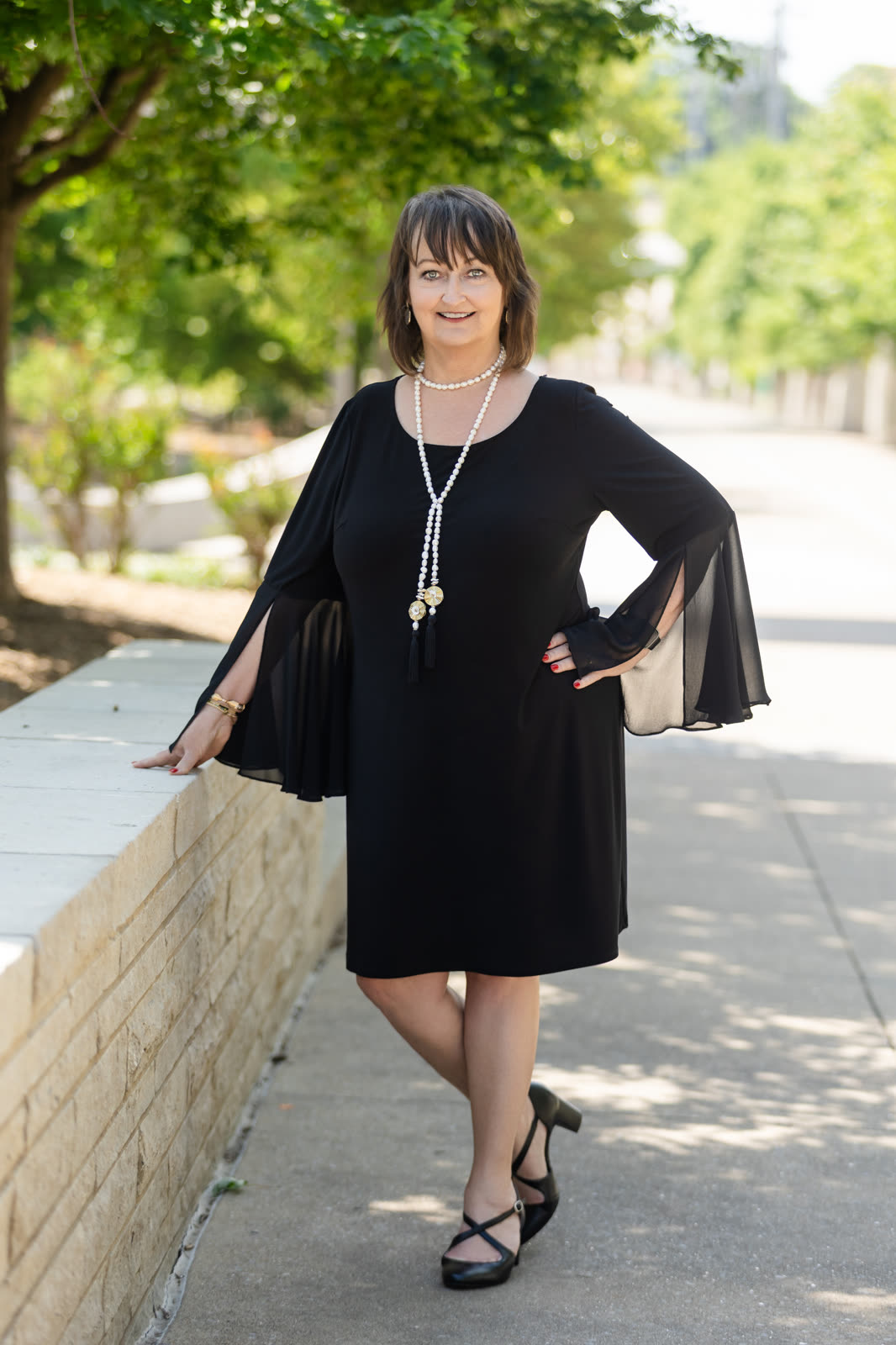
Off-white, cream, and soft gray do the job white was trying to do. Charcoal, navy, and deep brown do what black was trying to do, with texture that survives. The woman in the header photo is in solid black, and it works because the dress has texture, the light is soft, and there is no white fighting it. Black can be done with the right conditions.
Neon and Hot Saturated Colors
Highlighter yellow, hot pink, electric orange, lime: the camera overloads on these, and they bounce their color onto your skin. A neon top can give you a yellow-green chin before anyone touches a light. Save them for the weekend.
Green or Blue If There Is Any Chance of a Green Screen
The screen color gets removed in editing, and anything that color on you disappears with it. If there is any chance of a green or blue screen, ask ahead of time.
Big Logos and Slogans
A big logo dates the video the day the company changes it, and a slogan shirt is a distraction every second it is on screen. Your own company logo on a polo can be fine for a brand film if that is how your team actually dresses. Anything else, leave at home.
Fit Matters More Than Price
The camera reads fit long before it reads a label. A $40 shirt that fits across the shoulders beats a $400 one that pulls at the buttons, every time. Tailored beats expensive.
Two checks the night before. First, wrinkles. Creases you cannot see across a room are obvious on a 4K sensor under soft light, especially on cotton and linen. Steam or press it, and hang it in the car. Second, sit down in it. Most interviews are shot seated, and a jacket that looks sharp standing can bunch at the collar and gap at the front the moment you sit. If it needs constant adjusting, it is the wrong jacket. Unbutton it when you sit and let the crew tug the back hem down.
Give the Microphone Somewhere to Clip
Most interviews are recorded on a lapel mic (a lav), a tiny clip-on microphone that lives about a hand’s width below your chin. It needs an edge to grab: a collar, a lapel, a button placket, a tie, the neckline of a cardigan. A collared shirt or a blazer makes that easy.
A crew neck tee has nowhere to clip. The mic ends up taped under the fabric or pinned at the neckline where it rubs, and rubbing is a sound you will hear in the edit. If you prefer a tee, bring a jacket to go over it. A V-neck sweater with a shirt underneath is close to perfect.
Glasses, Jewelry, Shine, and Hair
Glasses and Glare
Glare is fixable. Anti-reflective coating helps if your lenses have it. If not, tilting the frames slightly down (push the arms up a little above your ears) moves the reflection off the lens. Best of all, tell the crew, and the lights get raised or moved so they do not bounce straight back. Do not take your glasses off if you always wear them. You will not look like you.
Jewelry That Makes Noise or Catches Light
Anything that makes noise is out: bangles that clack on the table, charm bracelets, long chains that tap the mic. Anything that catches light is a judgment call. Small or matte pieces are fine. A big polished pendant or oversized hoops will flash with every head turn, and the eye goes to the flash. A long strand of pearls like the one in the header photo reads as texture rather than sparkle.
Shine and the Five-Minute Fix
Lights are warm and nerves are real, so almost everyone gets shiny on the forehead and nose. The fix takes five minutes: blotting papers, then a light pass of translucent powder. Men included. Most crews keep powder in the kit, but your own in your shade will match better. Skip anything with shimmer or glow in it.
Hair That Frames the Face
Out of your eyes and off your face at the brow. Flyaways catch backlight and glow like a halo, so a little product or a quick smooth with a damp hand goes a long way. Do not try a new cut the day before. Give it a week to settle.
What to Wear on Camera for an Interview, a Brand Film, or a Headshot Day
A Video Interview or Testimonial
The short list for what to wear on camera for an interview:
- One solid mid-tone or jewel-tone top, collared or layered so the mic has a place to go
- A jacket or cardigan in a darker solid if you want a second layer
- No fine patterns, no pure white, no neon
- Clothes you can sit in for an hour without adjusting
A Brand Film or Weekly Series
Dress the way you actually dress at work, one notch sharper. If your team wears polos and jeans, wear a clean polo and jeans that fit. If you normally wear a suit, wear the suit. An owner in a three-piece suit when customers always see him in a quarter-zip reads as fake. For a recurring series, pick two or three reliable looks and rotate them. Viewers do not notice repeats. They notice when nothing matches.
A Headshot Day
A headshot is cropped from the chest up, so the top is everything. Choose a solid color with a defined neckline (a collar, a blazer lapel, a structured neckline on a dress) because that line gives the crop its shape. Bring a second top in a different color.
A Few Notes for Men, and a Few for Women
For men: a solid shirt in a mid-tone with a jacket is the easiest win. An undershirt should match the shirt or stay invisible, because a white tee under an open collar flashes. Ties are optional; if you wear one, a solid or a large pattern beats a fine one, for the same moiré reason. Shave or trim the morning of. If your legs will be in frame, wear dark socks that reach mid-calf.
For women: necklines that give the mic an edge work best, and a V or a soft scoop is kinder under the chin than a high crew neck. Blazers and structured cardigans photograph well and solve the mic problem. Watch for thin, drapey fabrics that cling or go sheer under strong light. Keep makeup close to your normal routine, a touch more matte and a little more defined at the eyes and brows, because the lights soften everything by a step.
Bring Two Options
Whatever you decide, bring a second top. The background might match your shirt, the light might be warmer than you expected, or you might spill coffee in the car. If you are torn, bring both and let the person behind the camera pick. We would always rather be asked.
The One Thing Not to Do
Do not change your whole look for the camera. A new haircut, a style you have never worn, a jacket borrowed because it seemed more professional: all of it shows up on screen as someone slightly uncomfortable in their own clothes, and viewers read that in seconds.
The video should look like you on your best normal day. Clean, pressed, rested, and recognizably you.
Where SDub Media Fits In
Most of our work is recurring video for businesses around Nashville: weekly series, podcasts, corporate events, and headshots. One real example: we run monthly headshot days for Coldwell Banker Southern Realty, rotating through their offices across Tennessee, so agents can come in once a month for an updated headshot.
For how a corporate shoot day actually runs and what it costs, our guide to Nashville corporate video production covers all of it.
Torn between two outfits for a shoot? Send us a photo of both and we will tell you which one the camera will like.